Well, I want to write about objects in outer space. But since most of them are estimates or theories that keep getting updated every year, I’m just going to enjoy the theories. While taking notes on what I find, so my brain doesn’t explode from processing millions of different pieces of information every second (well, a little dramatic is fine. The point is I want to write because my head feels like it’s about to burst).
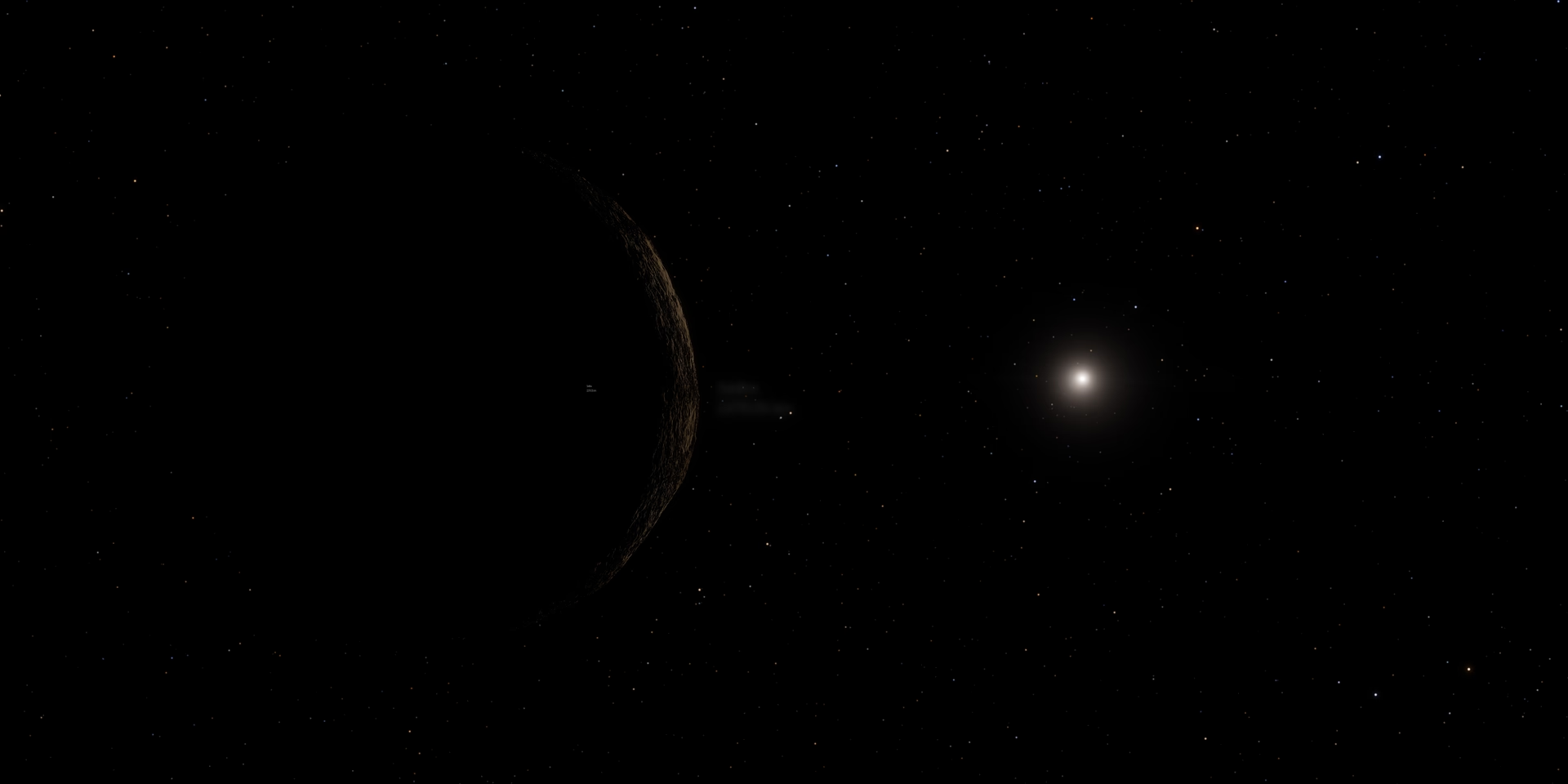
This object is called Sedna, or its official name 90377 Sedna. Discovered on November 14, 2003 by Mike Brown, Chad Trujillo, and David Rabinowitz. The name “Sedna” comes from the Inuit goddess of the sea, who supposedly lives at the bottom of the Arctic Ocean. This trans-Neptunian object (TNO) is a sednoid with an orbit that can’t be explained by the gravity of any known planets, making it an important object for understanding the early history of our solar system.
| Physical Properties | Estimated Value | Source/Method |
|---|---|---|
| Diameter | 995±80 km | Thermophysical Model |
| Diameter (Upper Limit) | 1,100−1,500 km | Spitzer Data |
| Albedo | 0.32±0.06 | Standard Model |
| Rotation Period | 10.273±0.002 hrs | MMT Photometry |
| Surface Temp (Average) | −240°C (33 K) | Distance Estimate |
Sources taken from NASA and various scientific literature.
“The last time Sedna was this close to the Sun, Earth was just coming out of the last ice age. The next time it comes back, the world might again be a completely different place.”
— Mike Brown, Discoverer of Sedna
Interesting things about Sedna:
- Located between the Kuiper Belt and the Oort Cloud
- Its perihelion (closest point in orbit) is around 76.1 AU or 11.38 billion km. While its aphelion (farthest point in orbit) is 883.79 AU or 132.21 billion km.
- Sedna has an extremely elongated (elliptical) orbit and takes about 11,400 Earth years just to complete one full revolution.
- It’s still unknown whether it has a moon.
- Sedna’s surface has a very red color, almost as red as the planet Mars.
Sedna is pretty fascinating to me, because it has layers of problems: too far away, doesn’t emit its own light, and has no moon. The only way to truly know anything about it is to send a probe directly there, and even that would take decades of travel.