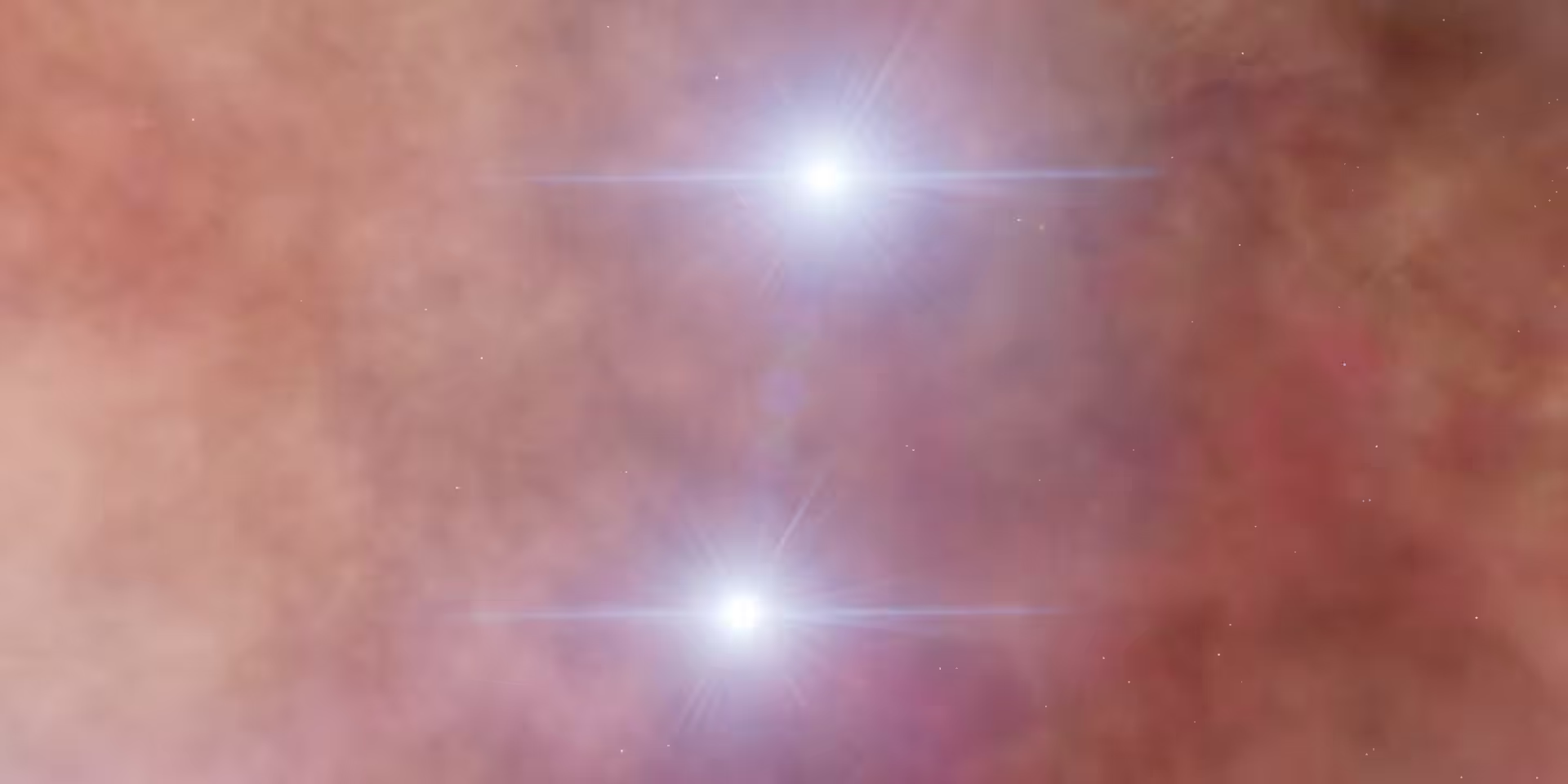
This is my favorite star system, and honestly the one that got me into astrophysics. It also happens to be the one that makes me feel like the universe (especially at the cosmic scale) still holds a ton of mysteries that are equal parts fascinating and terrifying. If yesterday I was writing notes about Sedna and its elliptical orbit with an eccentricity of around 0.855, there is a star system out there that blows even that number out of the water.
This system is known as HD 93308 or Eta Carinae, located approximately 7,500 light-years from Earth and first catalogued by Edmond Halley in 1677. Coming from the Latin word for “ship’s keel”, Carina was originally part of a much larger constellation called Argo Navis, the mythological ship of Jason and the Argonauts. In 1763, Nicolas-Louis de Lacaille split Argo Navis into three separate constellations we still use today: Carina (the keel), Puppis (the stern), and Vela (the sails).
Mass Parameters
| Parameter | Value | Method / Instrument |
|---|---|---|
| - mass function ( PHOEBE) | (Solar Mass) | From , , of orbit |
| - primary (from He II + -ratio) | Mass function, | |
| - secondary | Mass function | |
| Mass ratio () from -ratio | , | |
| Primary mass (model) | SPH modelling | |
| Secondary mass (if primary ) | SPH | |
| Primary mass (if ) | Mass function | |
| Secondary mass (if primary ) | Mass function compare WR22 () |
Physical Parameters of Car A (Primary)
| Parameter | Value | Method / Instrument |
|---|---|---|
| Star type | LBV (Luminous Blue Variable) | - |
| Mass loss rate () | Spectroscopy / wind model | |
| Terminal wind velocity () | Spectroscopy | |
| Stellar radius (model) | CMFGEN non-LTE model |
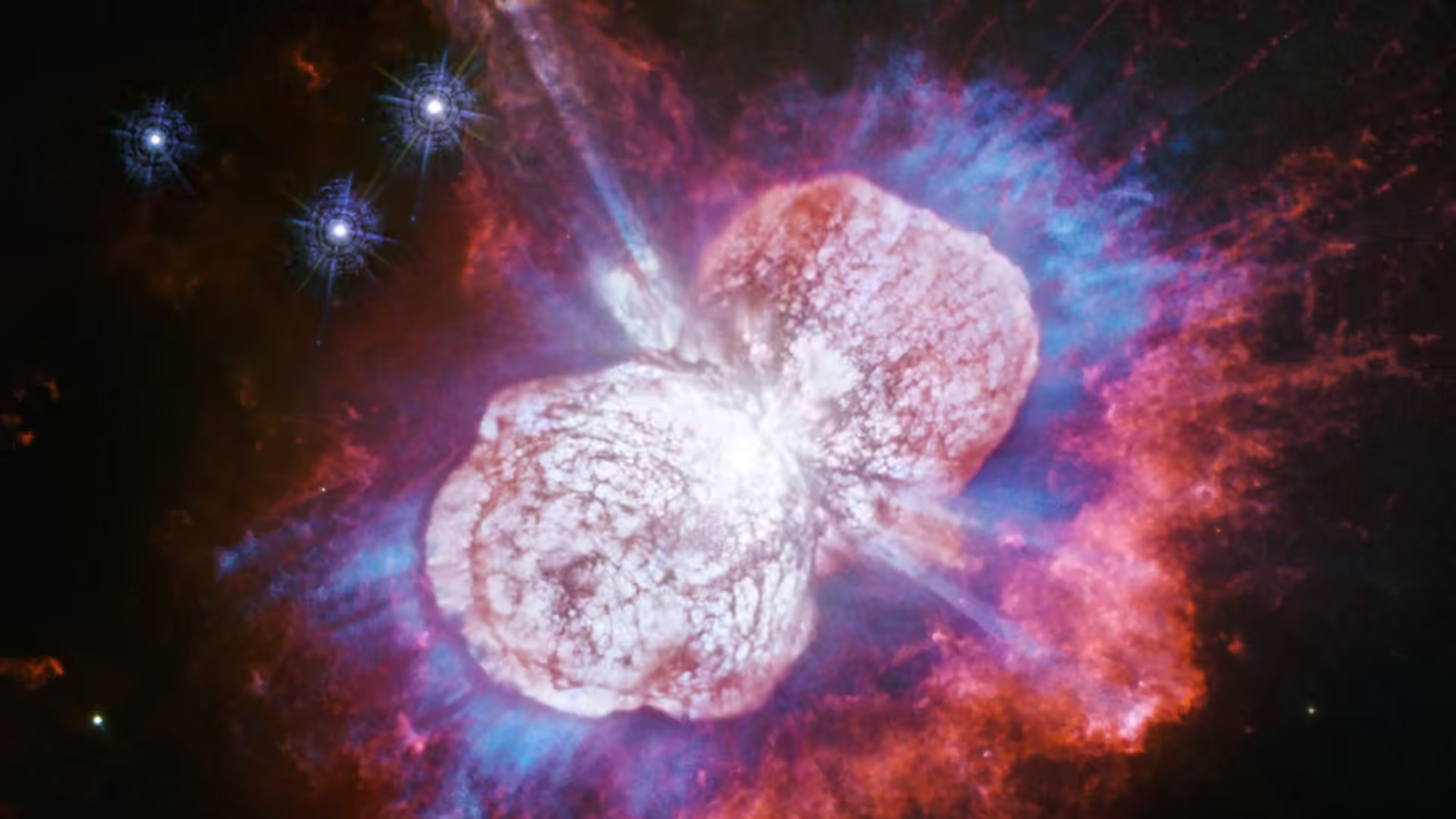
Physical Parameters of Car B (Secondary)
| Parameter | Value | Method / Instrument |
|---|---|---|
| Star type (hypothesis) | Wolf-Rayet (WNh or classical WN) | Merger model + spectroscopy |
| Mass loss rate () | X-ray variability analysis (RXTE, Swift, NICER) | |
| Terminal wind velocity () | X-ray colliding winds model | |
| Primary/secondary flux ratio | (in -band) | NIR interferometry (VLTI) |
| He II luminosity (near periastron) | (Solar Luminosity) | Optical spectroscopy |
Orbital System of Carinae
| Parameter | Value | Method / Instrument |
|---|---|---|
| Orbital Period () | 2022.7 days | Multi-wavelength monitoring |
| Primary Eccentricity () | (True) (Observed ) | Convolutional Keplerian Motion (CKM) model applied to Balmer lines PHOEBE MCMC (all data) |
| Secondary Eccentricity () | High-resolution spectroscopy (CHIRON), Gaussian centroid fitting of He II at apastron phases | |
| Argument of Periastron of Primary () | High-resolution spectroscopy, Gaussian decomposition & Convolutional Keplerian Motion (CKM) of upper Balmer lines, Gemini-South/GMOS | |
| Semi-major Axis () | Derived from 3D Smoothed-Particle Hydrodynamics (SPH) colliding-wind simulations | |
| Periastron Distance | Mathematically derived: using (CKM true orbit) or (SPH model) | |
| Apastron Distance | Mathematically derived: using (CKM true orbit) or (SPH model) |
With such high eccentricity and a periastron distance that close, the system becomes incredibly unstable. At that range, the stellar winds from both stars slam into each other at extreme speeds. The secondary’s wind is estimated to be moving at up to 3000 km/s when it crashes into material from the primary. On top of that, the primary holds the record for the highest measured mass loss rate ever recorded from a massive star.
A few other things that make this binary system so interesting:
- The secondary is believed to be hotter than the primary.
- Eta Carinae A (the primary) is one of only a handful of stars in our galaxy estimated to exceed .
- The Great Eruption in the mid-19th century was the event that blasted out enough material to form the Homunculus Nebula, which now wraps around both stars.
- One theory suggests the Great Eruption was triggered by a merger within a Triple Star System, while others argue it was simply the result of the extremely eccentric orbit.
- Despite being incredibly massive (estimated at least ) and outrageously luminous, the secondary has never been directly observed.
- It is one of the hypernova candidates in the Milky Way.

Whenever I try to simulate this in Universe Sandbox using the actual data, I almost always fail to keep the orbit stable haha. The closest I have managed is by dialing the eccentricity down to 0.85 and the semi-major axis to around 24 AU. I really need a proper simulator rather than a game, something like FLASH, PLUTO, or MESA.
Sometimes I also wonder: are there cosmic threats out there right now that science has not even detected yet? What is the end game for this binary system? Do they both collapse into black holes and spend eternity orbiting each other? Do they go hypernova as predicted and fire off a gamma-ray burst? Or do they just directly collapse without the fireworks? Weirdly, these terrifying questions are exactly what make me love these two stars so much (aside from the fact that they sit in one of the most beautiful constellations in the night sky lol). Well, I would gladly spend my whole life just watching a universe that is full of chaos, yet somehow looks breathtaking from where we stand.
Sources
- Strawn et al. (2023). The orbital kinematics of Carinae over three periastra with a possible detection of the elusive secondary’s motion
- Grant et al. (2020). Uncovering the orbital dynamics of stars hidden inside their powerful winds: application to Carinae and RMC 140
- Madura et al. (2013). Constraints on decreases in Carinae’s mass loss from 3D hydrodynamic simulations of its binary colliding winds